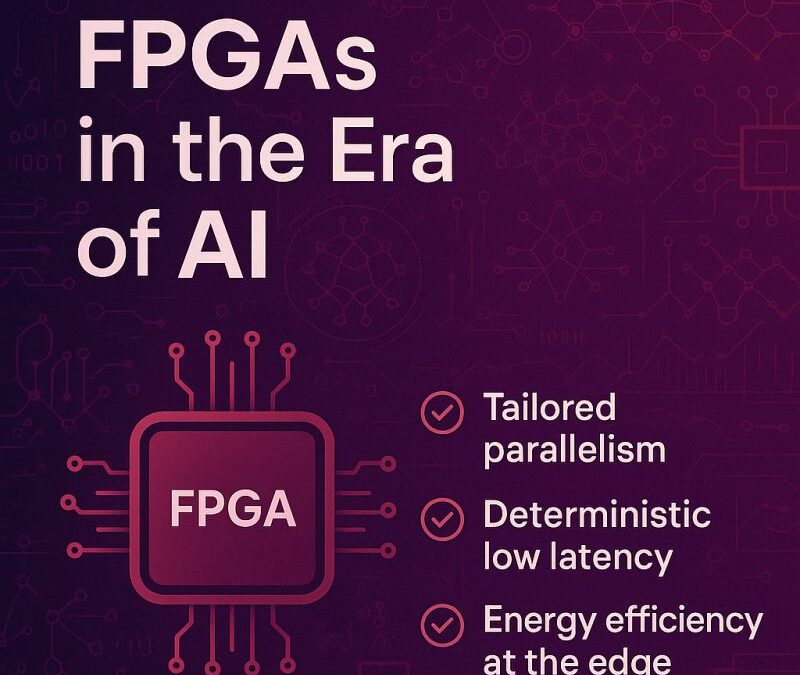
In the rush of AI acceleration, we often spotlight GPUs, TPUs, or cutting-edge ASICs. But quietly, FPGAs (Field Programmable Gate Arrays) are driving critical innovations across industries — and it’s time more engineers take a closer look.
🔍 Why are FPGAs relevant in the AI age?
Tailored parallelism: Unlike fixed architectures, FPGAs let us design pipelines and parallelism explicitly for our workload. This is a game changer for applications like image processing, NLP, and sensor fusion.
Deterministic low latency: In fields like automotive perception, robotics, and high-frequency trading, microseconds matter. FPGAs offer predictable, consistent latency that CPUs and GPUs struggle to guarantee.
Energy efficiency at the edge: When deploying ML models in power-constrained environments — from drones to industrial IoT — FPGAs often outperform general-purpose accelerators in performance-per-watt.
⚙️ But isn’t FPGA development too niche or complex?
That’s changing fast. Modern toolchains and frameworks are lowering the barrier:
Vitis AI (Xilinx) for deploying TensorFlow / PyTorch models on FPGAs.
hls4ml for translating ML models into FPGA firmware — widely used in scientific computing and low-latency applications.
FINN, an open-source framework for building quantized neural networks on FPGAs.
OpenFPGA, for those curious about FPGA architecture research.
Even at the language level, High-Level Synthesis (HLS) tools let developers design hardware using C++ or even Python, which then compiles into FPGA logic. This bridges the traditional gap between software engineers and hardware design.
💡 Our challenge (and opportunity) as engineers is to clarify
We need more shared learning, real examples, and honest discussions — not just marketing slides. Whether you’re an embedded developer expanding into AI, or a data scientist curious about hardware acceleration, there’s immense value in exploring FPGA capabilities.
🤝 Let’s build this knowledge together.
What FPGA + AI projects have you explored?
Which tutorials or open-source examples helped you most?